Hey y’all, welcome to More Lovin, the podcast that brings more laughter, light, and love into everyday life. I’m your host LeAnn Austin, and together we’ll rediscover the beauty of connection to your body, your mind, your spirit, and the people you love.
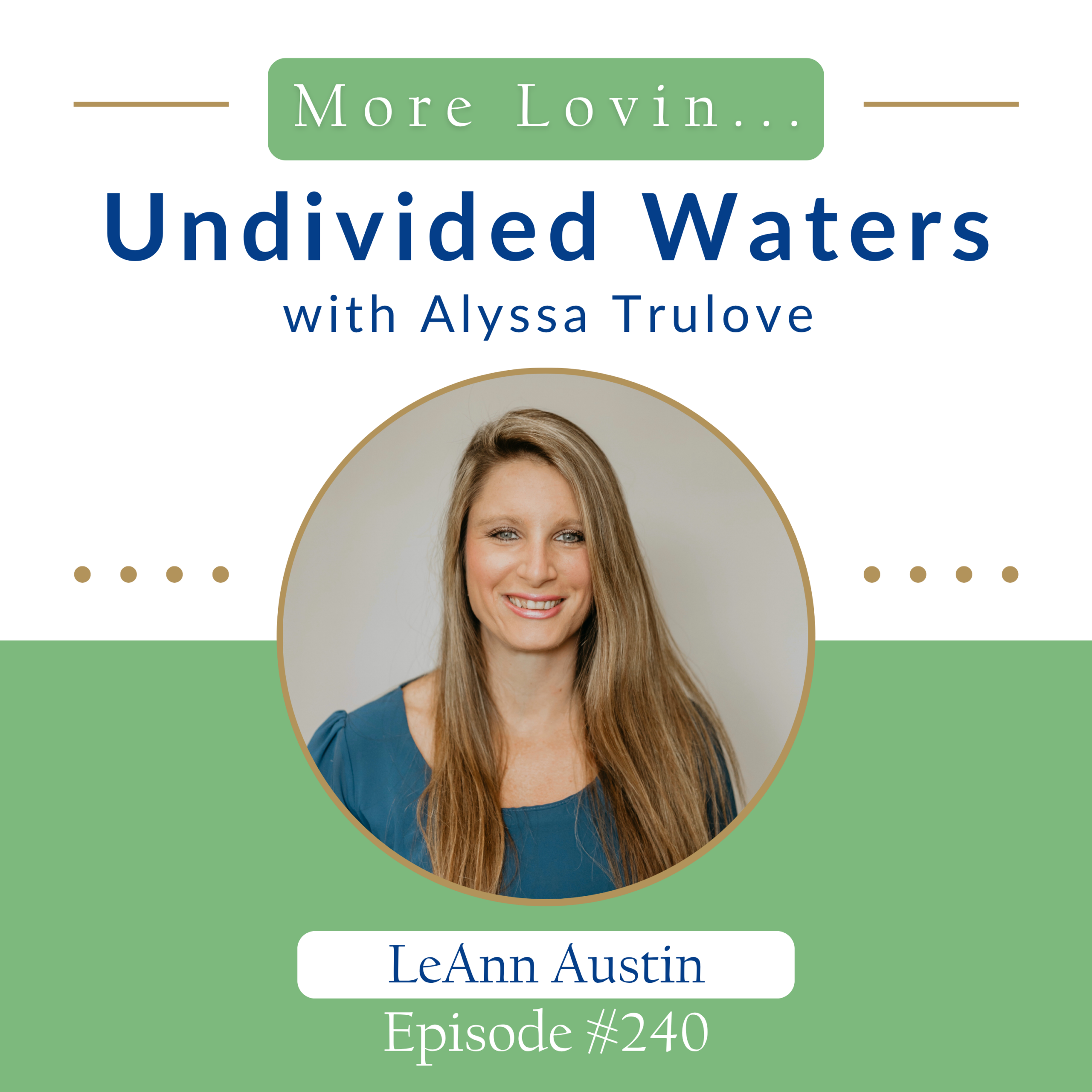
Today’s episode #240: Undivided Waters with Alyssa Trulove
I love observing and connecting with people who bring more lovin into their lives and relationships. It’s so inspiring to see how each person does it in their own way.
We have the incredible Alyssa sharing some beautiful love and relationship insights with us today. Alright Alyssa, tell us a little bit about you.
Hello everyone, my name is Alyssa Trulove, and I am a pediatric physical therapist. I have worked at Tender Ones Therapy Services for the last 12 years, and I am also a Kyle Pease Foundation Ambassador that I’ve been for, I believe, the last five years. And then I also am partially deaf, so that’s kind of like, shaped my life in a way that I still find little joys from a disability that I didn’t think would ever be a positive. But I have finally found the ways that it is a positive in my life.
Ahh, that is so amazing, and I love that you’ve turned that into a positive. That’s so cool Alyssa. Awesome. Thank you. Well tell us, how do you bring more lovin into your life and your business, and how has that impacted your relationships?
So I will say that one of my greatest superpowers, I would say, is the love that I share with everyone. I am a lover. I love to hug on my people. I love to tell them how much I love them. I want people to know that they are loved, and I feel like it goes all the way back to kindergarten when I didn’t know that I was partially deaf, and I was getting time out all the time for not listening.
And so, which is kind of ironic, because I feel like, you know, obviously I couldn’t listen. I didn’t know that I was partially deaf. So we found out that I was hard of hearing. I have about 35% in one ear, and then I have about 70% in the other ear, but I have high frequency loss, so it’s kind of like mixed hearing loss.
And so one of my biggest… So all the way back then, I felt very like people didn’t like me and that they were… the teachers were mad at me because I wasn’t listening. And so I feel like because of that experience, I want everyone to know how loved they are, and I maybe tell them maybe too much. I don’t know if that’s a thing.
But I just, because of that experience, I want all of, even my patients, I want them all to know that no matter what type of disability they have, they are worthy, they are loved, they’re gonna be doing something amazing in the world, and we just have to find their strength and their superpower. So I think that has kinda shaped into my career.
And then, with all my friends, and my husband and my family, I feel like I love giving gifts. I love calling and having long FaceTime chats with anyone who I don’t get to see very often, and I just, I want my people to know that they are loved and that they will do hard things in the world.
Ah, that is amazing Alyssa. And I’ve only had the blessing of meeting you once, but I could tell even in that moment not knowing you, you definitely radiate love. So that’s awesome that that is so important and impactful to everyone that is in your world. So awesome. Well, tell us… Thank you. Yeah. Tell us what is something you love about yourself and why?
Okay, so this is kinda crazy because I don’t think I ever would’ve said this, but I really love that I am partially deaf. So because of my disability, the world has been a lot harder, obviously, because I just, I can’t hear as well as everyone else. And because of that, I’ve had to read lips, so I’m a very good observer, and I have to be able to read people’s lips.
Because even though I can hear, I can’t always hear. So because I can read lips and because I’ve had to just watch and observe, I feel like I’m very intuitive about watching what people maybe need or don’t need. Or if they, maybe they need a hug today, maybe they don’t need a hug because then they might start crying because I know there are big emotions going on, so maybe I just need to give support in a different way.
And so I think being partially deaf has really shaped me into being a very inclusive person, because I knew what it was like to be left out. And even though in kindergarten when I was in time out, I don’t think the teachers weren’t intentionally leaving me out, but I felt like I was being almost shunned even though, because I didn’t know that I wasn’t listening, because I didn’t know I didn’t hear the instruction.
And so I feel like being partially deaf has really allowed me to be a really great physical therapist. It’s allowed me to really listen to my family’s stories and their hardships and figuring out ways that we can help them make their child as strong as possible, and include them and find different activities that they can be included in, not only in therapy, but then in the outside world too.
Which is kind of what led to my paddleboarding aquatic therapy program that I started 12 years ago with another colleague. And so yeah, so that’s been a really amazing program that I feel like has really allowed children with disabilities do a sport that they maybe never could have done before if they didn’t have that opportunity to try it in therapy. So I just kinda feel like my favorite thing about myself is my hearing loss, which is kinda crazy, but it just has allowed me to be very empathetic, very compassionate, very understanding to other people’s trials and tribulations in life, if you will.
And so it’s allowed me to really listen to the world around me, to see how I can best help and spread love in ways that people might need them. That is so cool Alyssa, that you’ve taken your disability and made it so beneficial to everyone around you. I love that, and I love that you love that. It’s not like, “Ugh, this is so frustrating that I’m partially deaf or that I have to read lips.” It’s like, “No, I’m taking this and maximizing it, and it helps me and it helps others.” So awesome. Way to go. That’s really cool. Thank you.
Yes, I always like to tell my kids, ’cause, you know, they’ll see it and they’ll ask, like, what my hearing aid looks like, and I’ll be like, “Oh, you know how people wear glasses for their eyes to help them see? I wear hearing aids. These are glasses for my ears, so they help me hear.” And so that’s been kind of cool. And especially with some kids that may not really understand.
Like, they understand glasses, but then they may see kids in a wheelchair and they’ll be like, “Oh, why are they in a wheelchair?” And I’m like, “Oh, well, you know, we all need help in different aspects of life. Some people need a wheelchair to help them walk. I need hearing aids to help me listen. You need braces on your feet to help you walk.” You know? And I’ve been able to kind of carry that in and weave those lessons in to my patients and not just my patients, but even just children and adults for that matter everywhere.
Yes. Which I bet that helps everyone, because whatever they’re dealing with, they’re like, “Oh, it’s okay,” because I love how you referred to the ears with glasses and things like that, very common things that it just makes it, it normalizes it, so that’s awesome. I love it. Because it is. I mean, I think what people don’t realize is that we all have something that we need help with.
Yeah. Like, we all need help, we all need love, we all need something to assist us in this world. It just looks very differently. It looks very different for many different people, and I think if we can normalize disabilities, that it’s just something, it’s just a part of us, it’s not our whole being, I think then that will just make the world a more inclusive place.
‘Cause I think part of the reason people struggle with inclusion is because they’re not quite sure how to include people. And I think that’s one of my biggest life lessons or missions, I guess, in life is to create a more inclusive world. And I think the way we do that is to normalize with things that we have going on so we can all help each other be better versions of ourselves.
Ah, 100%. I love that. Well tell me, when you think about connection with others or with yourself, what comes to mind? Yes, lovin like, and like high five, you know? Connection to me is the ability to see something in somebody else, whatever that looks like, right?
So maybe that’s for some people that’s the belief that they can walk across the hallway, right? Like that’s a big goal for a lot of my patients. Sometimes it looks like standing up on a paddleboard for the first time. Sometimes it looks like sending an email for the first time, but you may have not known how to send an email, right? Sometimes that looks like teaching people how to have a hard conversation or how to walk up a mountain 15 times if they’re gonna be at 29029 Sun Valley.
So you know, it looks different in all ways, but I feel like connection and the stories that we all bring to the table is what makes the world go round, right? Like, part of what I love about meeting people and being an extrovert, and you know, trying to find people’s strengths in, in their difficult time is learning their story, learning why this is difficult for them because sometimes things that are difficult for other people. I’m like, “Oh that doesn’t even phase me as being difficult because I can talk to a wall,” right? But for some people, talking to a stranger is very, you know, that can be very intimidating for introverts or really just for people that may need a little bit more time to come out of their shell.
And so for me, connection is finding something in common with somebody else, as we all have so many things in common, but we just maybe have to dig a little deeper to find what that commonality is, but it is very… We all have it, right?
And I think, you know, I mentioned 29029 Everesting, and that’s actually how we got to meet is through that wonderful community. And what I love about that community in particular, is the connections that you do meet with people, and you are going up the mountain maybe 15 times, maybe you’re only going 10 times, depending on what it is, but it doesn’t matter because the goal is to have connections with people and to find your people that can support you, whether you make it one time up the mountain or 15 times, and I think that you kinda carry that with you in life too.
Being able to, you know, think about like a hard work project that you have to do or a tough conversation you have to have, or a parent that is going through a hard time or, you know, a sibling that has a child going through a hard time or whatever it may be. Just, you know, finding a way to be with people, no matter what the circumstances are, and just finding that common ground and connection. And I’ve said connection like four times but. I love that word. That’s okay.
I think, my big thing that I also think of with connection is just, I think about it as like a high five, like a transference of energy. And, you know, some people don’t like being touched, so that’s totally fine. Then I’m gonna be giving them lots of energy from my words that I say or maybe just non-verbal language, you know, because some of my kids aren’t able to talk.
And so I think of other ways that I can kind of, show connection to those types of people. So anyway, that’s it. It’s so incredible because I love that there are so many ways to connect, and you’re looking for those to help the kids you work with and everything. So beautifully, beautifully shared.
Anything else you wanna share? And where can our listeners connect with you or learn more about your work? Okay. So one thing that I’m very proud of is from that paddleboarding aquatic therapy program that we started at Tender. I have already mentioned about the Kyle Pease Foundation, whose mission is to include athletes on and off the racecourse.
So part of my work with them is I started Undivided Waters. It’s a paddleboarding, kayaking, and swimming race that athletes of all abilities can participate in. And there’s even a children’s race that this year, or that we started for the first time this year, but then we will be doing next year as well.
We always do the race in August, usually the second weekend in August. And so this year it’s August 8th. Which by the time this episode airs, it will already be have happened. But it’s a race, all the money that is raised from this event goes to the Kyle Pease Foundation to help more athletes with disabilities be able to participate in different athletic events.
So it’s not just running races, it’s not just triathlons, it’s not just paddling races, right? It’s, they also are helping these athletes in life as well. So whether they have different grant programs that will help get a wheelchair-accessible van or renovations in their house that they may need to make it more accessible.
And so that program is really near and dear to my heart because they just do so much for so many athletes and so many people. And talk about a community. That’s a community and connection at its finest, right? It’s one of those amazing communities that no matter where you are, if I’m wearing a KPF hat, someone’s like, “Oh, I know my cousin did that.” Or, you know, and so it’s, like, a great starting point. I mean, any time I’m hiking up Kennesaw Mountain, I feel like I end up talking about the Kyle Pease Foundation to somebody at least once or twice while I’m doing a training hike. So that’s always very exciting, and I just want the world to know that we can make it more inclusive, and it’s very easy to do.
I think some people are intimidated by it if they haven’t been exposed or around it. And I think the more that we make it normalized and we demand for these kind of accessible races, the more people will just be like, “Oh, this is how it should be. This is not like abnormal to see someone in a wheelchair being pushed in a race, you know?
So anyway, where you can find me @atrulovey9. So A-T-R-U-L-O-V-E-Y-9 is my Instagram handle. And as some of my friends like to say, I’m an oversharer. But I just get very excited to share what I’m doing with my life. I like to share different travel tips and tricks, and airport yoga is a big thing that you’ll see all over my Instagram.
Also Undivided Waters website HERE and instagram HERE
I also post a lot about paddleboarding, Undivided Waters, and KPF. So, and 29029 for that matter. So yeah, I just love being able to connect with everyone. And honestly, I used to say that my dream job would to be an influencer of people wearing braids on Thursday with Purple Braid Thursday, which is a whole story for another time.
But and then doing airport yoga. I’m like, if people would just tag me in their posts that they’re doing airport yoga, that would just make me the happiest person ever. That is awesome Alyssa. And I’ll make sure I put the link to your Instagram in the show notes. So, so, so fun, and so many amazing things that you do. That’s awesome.
So lastly, tell us what’s your favorite question or quote about love, and how has it shaped your life and your relationships? Okay, so I don’t know that it’s my favorite quote about love, but it’s just my favorite quote in life is: “You can do hard things.” And I think that that is so, I’ve probably I think I’ve already said it in this podcast.
But I love that quote so much because it applies to so many things. It’s not just, you can apply that to your relationships, right? Like, marriage is hard. It’s not always rainbows and sunshine, right? And so, you know, we can do hard things. We can work through this challenging time together, right?
I look at it in friendships. Like, sometimes our friendships will ebb and flow, right? And sometimes somebody is going through a hard time and they can’t give as much as they normally do to a friendship, and that’s okay. You knowing that they’re going through a hard time, you’re gonna be there for them. Maybe you need to carry the weight of that friendship a little bit longer. But you can do that because they will do the same in return.
I think it also just, you know, setting goals for yourself, and I am one that I had signed up for a half Ironman, and I’m a terrible swimmer. And my swim coach said, “Well, the good thing is, is that we can only go up from here.”
And so, you know, one would take that like, oh, maybe you should not be doing a half Ironman if you can’t swim, right? But I just took that as a challenge and just kept reminding myself that I can do hard things. And when life does knock you down, and you don’t want to get up, and you don’t want to get out of bed, like, having that reminder ingrained in your brain has really helped me work through a bunch of tough times that I’ve had.
And I think it’s also made me a better therapist. And I think, and it’s really the quote that I say to my kids all the time. I’m like, “I know this is so hard for you to do this, to stand by yourself, but we’re gonna do it together. You can do it. You can do hard things.” So I just feel like it applies to so many things in life, and I feel like it also applies to love too, ’cause sometimes loving people can be really hard.
They, you know, people can push you away. They can, you know, they wanna try to push you away ’cause they’re afraid of love or whatever the situation is. And so I think just kind of knowing that you and I and the world can do hard things just is a good reminder that we can, we can all do it, and we can all do it together.
Ahh. So, so tender and amazing. Alyssa, thank you. Thank you. We can do hard things. Hmmm, something to think about. Thank you Alyssa, for sharing your love insights with us today. And here is to inclusion, normalizing compassion, and more lovin. Have a good one y’all.
Thanks for tuning in. If you’re ready to take what we talk about here and make it personal, let’s work together one-on-one. I’ll help you calm your nervous system, strengthen your relationships, and create more lovin, laughter, and calm in your life. You can find all the details at leannaustin.com
Until next time, keep choosing fun, connection, and a whole lot more lovin. Have a good one y’all.