
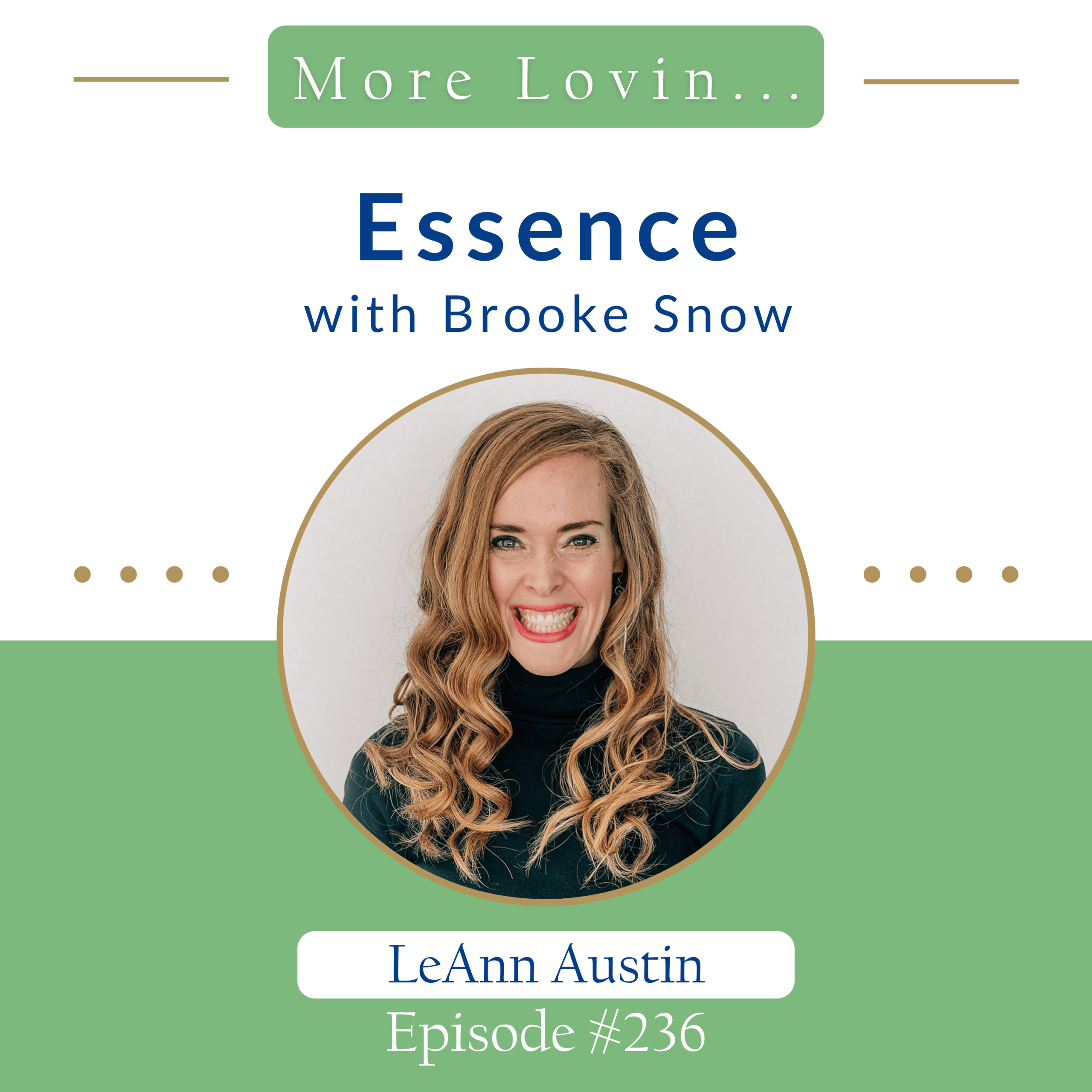
Hey y’all, welcome to More Lovin, the podcast that brings more laughter, light, and love into everyday life. I’m your host LeAnn Austin, and together we’ll rediscover the beauty of connection to your body, your mind, your spirit, and the people you love.
Today’s episode #236: Essence with Brooke Snow
I love observing and connecting with people who bring more lovin into their lives and relationships. It’s so inspiring to see how each person does it in their own way.
We have the incredible Brooke Snow sharing some beautiful love and relationship insights with us today. All right Brooke, tell us a little bit about you.
Well, thank you for having me. I’m excited to be here. A little bit about me, I live in northern Utah with two awesome kids and a great husband. I love the outdoors. I love music. I really love learning about spirituality.
I’m excited to talk about love because this is actually one of my favorite topics, and probably because I feel like I spent most of the first half of life, not very good at love. And really, it felt hard for me to love people and to feel love in return, and so it’s been something I’ve been curious about for a really long time.
And I feel like second half of life has really been a treasure trove in just my heart expanding and my ability to love myself and other people more than I was able to the first 40 years of life. And it’s like, wow, life is so much better lived with an open heart and less judgment, both directions, you know, inward to myself and outward to others. And so it’s one of my favorite things to talk about and teach on and to support people with, so happy to be here.
Ah, well, I am honored, and it’s interesting, I’ve been listening to Brooke’s podcast for years. And this recently it’s been all about love. And this I love and accept you, and so many things, so I’m just so grateful to connect with you and for you to share your wisdom with my listeners because you do exemplify love in so many ways and in what you share.
And so I just appreciate you being open and raw and vulnerable and sharing this with the world ’cause it’s really, really tender, and I’m forever grateful. So thank you. Thank you. You are welcome. I’m so happy to be here.
All right, so first thing, how do you bring more lovin into your life and business, and how has that impacted your relationships?
Yeah, this is such a good question, and I feel like there’s actually many layers that you could take with this I think. And all of them are really important. I don’t think there’s one that’s more important than another. And what I mean by that is I think love on the layer of, like, self-care and physical, being able to take care of your body and get enough sleep and eat really nourishing food is an act of love to yourself.
And I also think it’s an act of love to those you live with, especially in my case where I can get super hangry. And if I’m not caring for me, I have a hard time caring for other people. And so sometimes that’s something that we kinda overlook, and I think it’s a really important foundational piece to our ability to experience and to give. Like, the whole give and receive experience of love is really built upon such a simple foundation. And the body is a really important part of that.
The nervous system is a really important part of that. If you feel safe, you’re going to experience more of an open heart than if you feel unsafe. If you’re triggered into fight, flight, freeze, anything like that. We just, the body naturally contracts, and I think of that on both a physical level and a spiritual level. Like, our organs will contract and close up, and our heart contracts, and our ability to feel emotion contracts. And to have an open mind, like, it contracts. All of that just because of a nervous system.
So taking care of our body, taking care of our nervous system, I feel like is such a foundational piece to all of that, that oftentimes is overlooked. And in seeking for… I know for me, love for a long time was something I tried to work on from the mind. And more like a top-down approach, and there’s still something valuable about that. For my own experience, if I can work from the bottom up, like, I work with the body first, then it’s so much easier for my mind to be loving, for my mind to have good thoughts, for me to let go of judgment. For me to have more hope about something rather than going into doom and gloom and irritation and frustration.
And so I think that’s a really important element to consider, is that foundational piece of caring for the body, caring for the nervous system, and then it opens you up to so much more after that.
Ahh, that is gold, and you are spot on. I’ve been studying the nervous system for the past few years with Leah Davidson, and I just love that starting, like you said, bottom-up approach. Really honing in on the feelings rather than, you know, what we’re thinking about. Let’s start with our body and what we’re feeling. So I love that you’re teaching that and sharing that as well. That’s beautiful.
Yeah. That’s been the part that I think has given me access to experiencing love more than decades worth of trying to study it, and decades worth of judgment of myself for getting angry or getting irritated or not being so loving. And I should just be able to do X, Y, Z, and I can’t do it from the mind.
My experience is just I gotta go the other direction. Wow. And that’s where I can have more access. 100%. So when we stop shoulding all over ourselves. Yeah. And we’re feeling and really just honing in on what we feel and being okay with that. It’s okay if we’re angry, mad, sad, whatever. It’s okay, and just loving ourselves through all of that. I love that. Yeah. Beautiful.
All right, so what is something that you love about yourself and why? I really love my desire to learn and to understand. And I feel also like my life challenges have been a catalyst for some of my greatest lessons. And I love my ability to be able to find meaning and growth in the hardest stuff that I’ve been through.
And that, to me, has been… It’s a skill, but it’s also been something that has helped me return to myself. Like when I can interpret what I have been through and interpret the challenges that I’ve been through and that I am going through, and to just be able to see what is, where is the wisdom? What am I supposed to see here? What am I supposed to learn here?
That’s been something that has been a part of my worldview and the way that I’ve treated life for as long as I can remember, and now I feel like I’m able to look at that with more love and less judgment. Meaning, I feel like I spent the first half of life, I would take those, that same strength, I would take into judgment in so much as how can I fix myself? How can I fix this part of me that needs to not be here anymore?
So there’s this judgment that was there, and now I’ve been able to take that same desire to learn and instead of coming at it from a place of fixing, now I’m able to come at it from a place of curiosity. And this isn’t about fixing myself, it’s about discovering.
Like, what part of me is sad right now? Instead of, I need to fix the part that gets sad. What part of me is really irritated right now? Instead of I need to fix that. Like, if I was a better person, I wouldn’t feel this way right now. And now it’s more a curiosity of oh, I wonder what’s up? What part of me is feeling that irritation? What does she need? How can I support her right now?
And so it’s been interesting to see that strength also evolve into a more loving and supportive strength too. ‘Cause our strengths can have shadow sides. And so it’s been interesting to see both sides of that, and to be able to notice when I go more into the shadow, and can I balance things out again?
Oh, that is so beautiful, and I think when we drop the fixing part, what if there’s nothing to fix? Oh yes. Exactly. It’s like I used to be big time perfect- no. So it all has to be a certain way and everything, and over the past eight, 10 years as I’ve learned to let that go, that is life-changing.
It is. Oh, I love that so much, and I love that you love to learn. And to top that off, you love to learn and you love to share what you’re learning. I do. So yeah, I love that because we all get to benefit from that, you know. So thank you. That’s wonderful. Thank you.
All right, so when you think about connection with others and with yourself, what comes to mind?
I really love this question. And I think the best response that I have is that it’s been really helpful for me to look at my identity in two parts. And I would say part one is my ego. Mm-hmm. And that’s just my sense of self that identifies with certain things. Like, I am a mom, and I am a podcaster, and I am a seeker and a learner, and I’m an outdoors person.
Like, it’s just all these identifications that I have, I think ego can, just like I mentioned earlier, there can be a shadow side to ego, and there’s actually a really helpful, needful, healthy side to ego as well. And so this is part one. Like, I see who we all are as having an ego self and then an essence.
Ego and essence. Mm-hmm. And ego is one of the shadow sides I think can be judgment, and it’s just a limited view of who we are and who others are. And when I think of essence, like we all also have essence. That would be the part of who we are that is underneath all the layers of ego.
It’s underneath all the identity, all the judgments that we have about ourself and the world and life and everything. Underneath all that, I believe we have an essence, a divine essence in, that is actually love itself. Yes. There is a part of us that has never been disturbed. It’s always at peace.
It is the awareness. It’s like, who is watching the world through our eyes? And it is just always at peace, always love. And so it’s been helpful for me like, when you ask this question about connection. There are people that I feel disconnected from in my life. And I believe the reason that I feel disconnected is because of ego.
My ego, their ego. We each have judgments about the other person. There are people who it’s better for me to have a more distant relationship with. Yeah. And on the level of essence, I can still feel that connection. Like, on the deep level of essence, that part of me and that part of them, that is love and undisturbed, and is not any of the judgments and the things that have happened to us, and the things we’ve said, and our world views or anything like that.
So to me, I feel that connection if I’m able to get in touch with the essence of who I am, and I can get in touch with the essence of who another person is, that’s where connection exists to me. Like, on the unbreakable level. And like I say, yes, there are people I feel disconnected from. And that’s like a surface level disconnection, because I believe that the true deep connection is actually never lost.
We just kind of fall in and out of our awareness and experience of it that’s there. And so that’s a really helpful reminder to me, because I think the joy of life is when we feel connection, when we feel connection to ourself, when we feel connection to other people, and it’s only to be found when we can drop down.
Like, when we can get to that beautiful layer of like, okay, this is a judgment-free zone, and we’ve been able to let go and forgive, and just be at that place that’s undisturbed. And for some people, there may be people that we don’t get a lot of in person experiences with their essence. And yet for me, just like knowing that it’s there and almost in like a meditative way. Just like really visualizing that is just a helpful way for me to feel like I’ve got that connection. And it’s something that can never be lost.
Oh, I love that so much, and I’ve never tied the word essence in with connection, but I will moving forward now. Because that is such a beautiful way to look at essence. And like I’ve heard you say in your podcast, just really going into your heart, getting out of our mind and going into our heart and feeling that essence and that connection.
Yeah. Another thing I would share with that that’s been helpful for me, like I’ve mentioned a little bit about judgment. And we’ve talked a little bit about getting into the heart, and for me, it’s helpful to look at the mind as a dualistic organ. If you look at the brain on a table, like anatomy, like there’s two hemispheres.
There’s a right hemisphere and a left hemisphere, and it’s so normal and natural for us to see the world in black and white. We have a right and a left. It’s a dualistic perspective, and that is what judgment is. Judgment comes in, and it’s like, “This is right. This is wrong. This is good. This is bad.” And that is a very helpful tool for our learning and development in our life.
And it can have a shadow side also, and it’s helpful. Like, it’s all about keeping things in balance. And the way I like to think of things is like that’s our mind, and then when we drop down to the heart, I symbolically just love to look at the heart as the organ of like wholeness. It’s not divided.
And that’s a place where it’s the heart, in my mind, is able to hold both sides of polarity. And so the mind has a hard time with that. It has to like, it wants to choose. It wants to like say, “This is the right side. This is the wrong side.” “This is good. This is bad.” And the heart just being that place where everything gets to exist here.
So going back on what I said earlier about like maybe I’m angry, maybe I’m irritated. If I’m in the mind, it’s gonna create a judgment on that. And, you know, there’s an identification of I am a bad person for being so irritated or upset or angry, or I lost my temper, or I have a judgment about this person and I really don’t like them. And that’s all in the mind.
And when we can drop down into the heart, it’s like there doesn’t have to be the division. Like, everything gets to exist without exile. Ahh. And so it’s like, I can be with the part of me that’s irritated in the heart. I can’t do that in the mind, but I can if I drop down here, I can come down to the heart. It’s like I can be with the part that is irritated or angry or sad or hurt or betrayed or whatever is present, and I can be with that part without needing to fix, without needing them to go away.
It’s just, that part gets to be here and to be loved, to be accepted, to be validated. Like, there are innocent reasons that the parts of us feel what they feel, and the more I’m able to offer that to myself, the more whole I feel. And the more I’m able to offer that same wholeness to others.
If I’m able to be with the part of me in love and acceptance that is super irritated or angry and upset, I can be with the part of my son or husband or daughter that is irritated and angry and upset because I’ve already practiced that with myself, and I know what it feels like to be in that space where we don’t have to exile any of us.
We don’t have to judge. And that’s been helpful for me to kind of think of the mind in that way and the heart in that way. And so that invitation to come into the heart, I have this awareness of everyone belongs. Yeah. All the parts get to be here. Let’s let everyone share their piece. What do they need to say? And let’s coexist. What things need to happen so that we can just live in harmony?
Oh, that is so tender to me, and thank you for teaching us that because just the visual of, you know, the mind, the two parts for sure, and then the heart. Even something I’m going through right now just thinking about, if I can just put it in my heart and have room for all of it. Yeah. That is a space for all to be there.
And you are spot on. Our mind is like, yes, right, wrong, fix whatever, blah, blah, blah. Yeah. It’s like, let’s just go to our heart. Thank you for sharing that. That’s beautiful. Yeah. That’s beautiful. Okay. Well, anything else that you’d like to share, and where can my listeners connect with you and learn more about your work?
I have a podcast on iTunes. It’s called Creator Field Notes with Brooke Snow. I currently have three episodes that I release a week that will go through September, and then I’ll probably reel it back into one episode a week from that point on. So that’s the best place to connect that way.
I’m not really active on social media. I do have a newsletter that I love writing every week. An email newsletter, and you can just go to brookesnow.com. I share just my insights of what life lesson I’m learning this week. And I write it all by myself, meaning that AI has not written my newsletter or anything like that.
Like, it is a spiritual practice for me, it is my newsletter moment. And I spend several hours a week just prepping that. It’s a way for me to integrate and embody what I’m learning in life right now about love, and then I love being able to share that with other people too. So that’s where you can find that.
I love that, and I highly, highly, highly recommend Brooke’s podcast, and her newsletters as well. I get so many insights. I just love listening to your podcast. There’s so many things that I remember from years ago when I took your certification, like the floors and ceilings and different things will just pop into my mind. I’m like, “Oh, yes, let’s do…” So good. So many great things. Oh good. Thank you. So take a listen. Yeah.
All right, so what’s your favorite question or quote about love, and how has it shaped your life and your relationships? Yeah. This is something that is new for me.
It was a quote from M. Scott Peck, and from his book The Road Less Traveled. When I say new, I mean I came across this in the last couple of years, and it’s just been so helpful in navigating some hard decisions and challenges. And this is what he says. And he is a psychologist, and he says, “Love is the will to extend one’s self for the purpose of nurturing one’s own or another’s spiritual growth.”
I’ll read it one more time. “Love is the will to extend one’s self for the purpose of nurturing one’s own or another’s spiritual growth.” And the reason I love this, I mean, it’s not the most poetic or wildly like, inspirational quote about love that I’ve ever read, but I find it very practical and very useful in the sense that oftentimes our society, I think, can think of love as an emotion. And what he’s saying here is it’s the will to extend yourself for your own spiritual growth or someone else.
And that means that there, there may be choices sometimes that are hard for us to make. They require us to spiritually grow in order to make that choice. And maybe that looks like creating a boundary. Maybe that’s like speaking up for yourself. That requires some spiritual growth. I just think it’s really useful to look at it in that way, like oh, that’s what love is, the ability to extend myself for my spiritual growth or someone else.
And I have one other thing I could share. Yes please. You share everything you want. I love it. Because, I talk about the heart and being able to make space for both sides of a polarity. And one polarity that has just fascinated me a lot, because I used to have a lot of judgment on this polarity, is the polarity of conditional love and unconditional love.
And it’s just interesting, maybe those who are listening right now, to just think of those two polarities. Which one do you tend, in your own judgment, to feel like, “Oh, that’s the good one”? I know for me, I lean towards the unconditional love. I lean towards that and think anything that is conditional is harmful or bad, and that’s my mind. It’s looking at it from the mind.
And when I can drop down into the heart and I can hold both of those, it allows me to be able to see that, oh, conditional love, there are actually gifts that conditional love offers us, and there’s a shadow side. There’s a gift and a shadow. And there is gifts that unconditional love offers us, and there is also a shadow.
The shadow is created when you isolate, which is what the mind does, and it’s like choosing of only one side can be right. But when we’re in the heart and both can be present, that’s when you can have balance.
You get to have the gift of one side of the polarity, and you get to have the gift of the other side of the polarity. So just, I’ll circle back to how this fits into this quote, of like extending oneself for your own or another’s spiritual growth. I believe a lot of us, you can take either one of these polarities into their shadow.
For example, what would the shadow side of conditional love be? I see the shadow of conditional love being love has to be earned. It has to be something you earn and you deserve, otherwise you can’t have it. There are conditions that have to be met.
And then if you go to the other side, what would the shadow side of unconditional love be? And I see the shadow that appears there is no boundaries. There’s no conditions. Anything goes. We just can be a doormat and get walked all over. And so when you’re able to take the gift that both of them offers, we get to have some balance.
And I learned this from Mother Nature. I learned it because of looking in nature. I could see evidence of both. I could see evidence of Mother Nature being absolutely unconditionally loving, and I could see that there also exists conditional love in nature too.
And so where do I find the unconditional love? I find that in the sunshine. And like a familiar Bible verse says, the sun shines on the just and the unjust. It doesn’t matter who you are, what you believe, what color skin you have, where you live in the world, it does not matter. The sun shines on you every single day. It is absolutely unconditional. The rain falls on the just and the unjust. Like unconditional love.
I love, like I mentioned, I love nature. Like, I can go run into the forest so flipping mad, and she receives me with no judgment. And I can go there totally peacefully, and she receives me with no judgment. And it’s just this beautiful display of unconditional love. And then yes, there are conditions in Mother Nature too.
One example that shows up there is I cannot grow a palm tree in Canada. It’s just not gonna work. Why? Because it’s not the right conditions. It’s not the right climate at all for that particular tree species to be able to thrive and to grow.
And so for me, the lesson that I take from Mother Nature here is that where conditional love shines is in having discernment about what you need so that you can grow. What are the conditions you need for growth? What, and I would say safety also goes into there. Ah, for sure. Like, what conditions do you need to feel safe? That’s gonna be part of your growth and your thriving.
And where conditional love gets super sketchy and in the shadows is when we put worth. When we put our worth into conditions. Like, nowhere is that appropriate. Yeah. But having conditions so that you can be healthy, and safe, and thrive, and grow is absolutely necessary. And then we go over to unconditional love, to me, this is where our worth belongs always. Yes. Worth always is in the zone of unconditional always.
And so to me, that’s where that balance lies of conditions are helpful for knowing how you can grow, and that relates back to this quote, right? “Love is the will to extend oneself for the spiritual growth of you or another person.” So there will be times where you need to make some decisions of, what do I need so that I can thrive, and I can feel safe, and I can grow?
And what does this other person need so that they can thrive, and grow, and be safe? And sometimes that means distance. Sometimes that means no contact. Sometimes that means, just the nature of our relationship is just different. And sometimes it’s the opposite direction. But always, always, always, what is unconditional, is our own worth, our lovability. We are always loved. Yes. That’s the essence of who we are and who other people are.
And so keeping that in mind, I think, is helpful for making those choices of extending ourself so that we can find the balance. Yeah. It’s always, like, find the balance of both what are the conditions that are needed, and I’m always loved and accepted. Yeah. This other person is always loved and accepted. And you’re gonna feel that when the conditions are correct for you. Yes.
I’m so glad you tied in the conditions and unconditional because I’m always like, okay I’m working on unconditional love, which is great. I think there’s so much wisdom and merit in going there. And also remembering it’s okay when there are conditions. Yes. It’s an okay thing. So thank you for tying that in ’cause I really love that. And extending ourselves for spiritual growth, you know, for ourselves and for others. Hmmm, something to think about. So beautiful.
Well, thank you Brooke, for sharing your love insights with us today. I’m so blessed that you were here with us, and I really appreciate it. It’s been a joy. Thank you for having me. Well, here is to essence and connection and more lovin. Have a good one y’all.
Thanks for tuning in. If you’re ready to take what we talk about here and make it personal, let’s work together one-on-one. I’ll help you calm your nervous system, strengthen your relationships, and create more lovin, laughter, and calm in your life. You can find all the details at leannaustin.com
Until next time, keep choosing fun, connection, and a whole lot more lovin. Have a good one y’all.